Only the oaks remain.
For twenty-two months during the Second World War, one of the United States government's earliest mass-detention sites sat on a patch of oak-shaded canyon floor a half-mile from the 210 freeway alignment. The barbed wire came down in 1943. The buildings are gone. The oaks are still there.
A CCC camp, seized the day after Pearl Harbor
The site began its institutional life in May 1933 as the La Tuna Civilian Conservation Corps Camp, one of the many New Deal work camps that President Roosevelt established across the country during the Great Depression. Situated at 6330 Tujunga Canyon Boulevard — fourteen miles northwest of downtown Los Angeles and six miles north of Glendale — the camp housed workers doing fire-road and flood-control improvements in the Verdugo and Tujunga foothills.
That changed instantly on December 8, 1941, the day after the attack on Pearl Harbor. The U.S. Department of Justice, acting through the Immigration and Naturalization Service, took over the CCC camp for the purpose of detaining and identifying so-called "enemy aliens." Within eight days, the first group of detainees arrived.
"Tuna Canyon Detention Station received its first enemy aliens who had been taken into custody by the FBI on December 16, 1941, and thereafter operated as a clearing-house for the male Japanese enemy aliens arrested in Southern California."
Who was held there
The Tuna Canyon Detention Station was a temporary clearing-house — a sorting and processing facility. Most detainees were held for weeks, not years, before being transferred to longer-term Department of Justice camps at Fort Missoula (Montana), Fort Lincoln (North Dakota), and Santa Fe (New Mexico). The camp had a capacity of roughly 300 prisoners at any one time, but over the course of its operation, more than 2,000 people passed through.
The detainees were not convicted of anything. None were given legal counsel. No evidence of "fifth column" activity was ever produced against them. They were held under the authority of Presidential Proclamations 2525, 2526, and 2527, issued on December 7–8, 1941, which in turn relied on the Alien Enemies Act of 1798. The detainees fell into four broad groups:
- Japanese Issei men — first-generation immigrants from Japan, arrested in large numbers across Southern California. From December 1941 through May 25, 1942 alone, 1,490 Japanese men passed through Tuna Canyon.
- German and Italian immigrants — a smaller but significant group, picked up on the same Justice Department watchlists.
- Japanese Peruvians — civilians forcibly removed from Peru by the U.S. government as part of a wartime deal with Latin American allies, brought to the United States and held without charges.
- Community and religious leaders — Buddhist priests, Japanese-language schoolteachers, newspapermen, and business leaders were targeted in disproportionate numbers, as the government viewed cultural leadership as a proxy for political risk.
M. H. Scott, the officer-in-charge, was remembered by detainees as unusually humane; letters of gratitude to Scott are still on file at the National Archives. The Quaker missionary Herbert Nicholson visited regularly, serving as interpreter and character witness at hearings. On May 28, 1942, Francisco de Amat, the Spanish consul at San Francisco — Spain was the neutral power representing Japanese interests — visited the camp and filed a formal report with the State Department on detainee concerns.
Closing, and afterlives
The station closed on October 30, 1943, once the larger permanent camps were fully operational and Tuna Canyon's sorting function was no longer needed. The buildings were converted into a Los Angeles County probation school for boys, and for nearly two decades the site continued in a new custodial purpose under County operation.
In 1960, a partnership of Los Angeles-area doctors purchased the land from the County for $7.6 million (as a tontine-style partnership designed to dissolve upon the death of the last partner) and opened the Verdugo Hills Golf Course in June of that year. The detention camp barracks were demolished; the driving range and overflow parking were built directly on top of where they had stood.
The site today
The former detention site at 6433 West La Tuna Canyon Road was recognized by the City of Los Angeles as Historic-Cultural Monument No. 1039 in 2013. Advocates have fought proposed housing development on the parcel in the years since.
Who remembers
The Tuna Canyon Detention Station Coalition, a nonprofit founded in the early 2010s, has led the effort to preserve the site's memory — organizing the 2013 monument designation, producing the traveling exhibit Only the Oaks Remain (which ran at the Japanese American National Museum from December 2016 through April 2017), and fighting through years of litigation when the property's owner, Snowball West Investments, sought to remove the historic designation and build 215 housing units.
That lawsuit was dismissed; the monument designation stands. In December 2019, the Los Angeles City Council denied a zone change that would have allowed the housing development. Snowball West appealed, and as of recent years the appeal remained pending.
Today, the barbed wire fence, guard posts, and barracks are gone. Only the oaks remain.— Tuna Canyon Detention Station Coalition
For anyone who drives La Tuna Canyon Road regularly, the site is almost invisible from the road — a slope of grass, a fringe of old oaks, and the now-shuttered golf course behind them. The City's historic monument sign, installed in 2018, is one of the only markers. If you stand at the right spot near the oak grove, you are standing where hundreds of men, most of whom had done nothing wrong, slept under guard a lifetime ago.
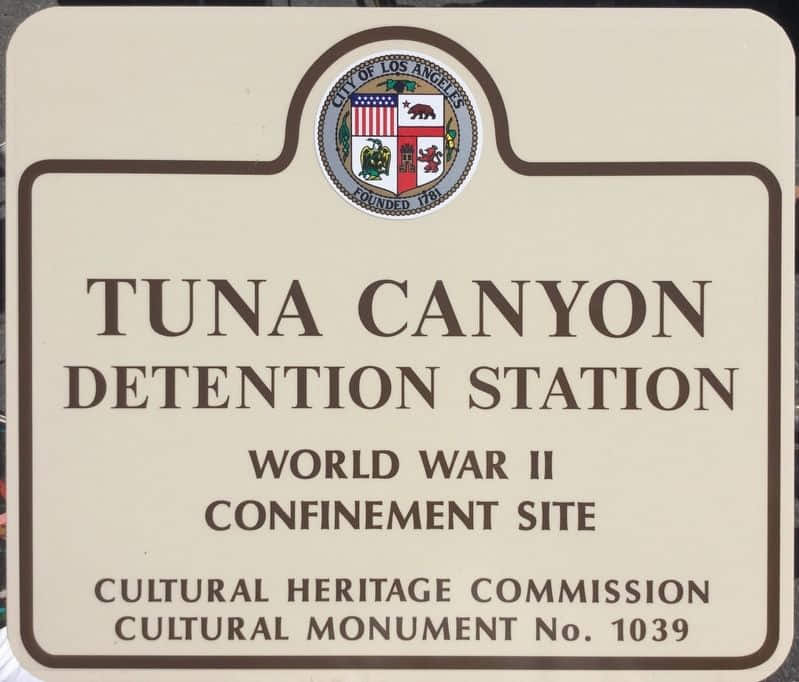
Cultural Monument No. 1039 — the City of Los Angeles marker unveiled at the Tuna Canyon Detention Station site on April 12, 2018, at La Tuna Canyon Road and Honolulu Avenue.
Photograph by Craig Baker · Historical Marker Database (HMDB)
Voices from city hall
The civic climate that produced detention sites like Tuna Canyon extended into the highest levels of Los Angeles city government. The city's wartime mayor, Fletcher Bowron, used his regular radio addresses to agitate publicly and forcefully for the removal and incarceration of Japanese Americans — many of them U.S. citizens, many of them his own constituents. A plaza in downtown Los Angeles still carries his name.
Putting Them Where They Could Do No Harm
A short documentary making the case for renaming Fletcher Bowron Square in downtown Los Angeles. Eschewing narration, the film draws on Bowron's own wartime radio addresses — voiced by Maciek Kolodziejeczak — and juxtaposes them with testimony from Japanese Americans who appeared before the Commission on Wartime Relocation and Internment of Civilians. The title comes from one of Bowron's broadcasts.
Bowron's broadcasts are on the record. They are worth hearing in the mayor's own voice — not to re-litigate what happened, but to understand that the Tuna Canyon Detention Station did not arise in a political vacuum. The pressure for mass incarceration came from many levels of government, including the one a few blocks from City Hall.
Learn more
The authoritative source on Tuna Canyon history is the Tuna Canyon Detention Station Coalition, which has led the preservation effort since the early 2010s and holds the largest archival collection — including the 50+ photographs taken by officer-in-charge Merrill H. Scott during the station's operation. The Coalition is an active nonprofit; their site includes a downloadable history booklet, detainee biographies, and information about the permanent memorial project.
- Tuna Canyon Detention Station Coalition — official site, archival collection, booklet
- Densho Encyclopedia: Tuna Canyon — scholarly reference entry
- Japanese American National Museum — Only the Oaks Remain exhibit
- Historical Marker Database — HCM #1039 marker page with visitor photos